This page serves as a summary of how ppa is used by me, the developer. In my experience, many of the users that consistently and regularly use the product, follow a similar pattern. These can be considered a list of best practices.
When is it used?
PPA is useful all year, but we (my father and I) use it primarily through the winter and early spring. In practice, that ends up being from about October to March. This is the time of the year when many decisions are being made on the next crops. We also want to be ready with knowledge of our breakeven costs to take advantage of the normal seasonal rally in the spring.
How many crops, etc.?
By the time we've finished entering the data and refining it, we would have a lot of crops set up. Just looking now at the app file we used for 2021, we have 43 crops entered in. We have 7 scenarios, but only one of them is actually for the projections for the 2021 farming year. That scenario has 35 fields entered in, so we are not using all of the crops in that scenario. That's completely normal. With the ease that a crop can be copied and then modified, you'll very likely have multiple similar crops.
If you are highly detail-orientated, you'll need to make a lot of crops. You can start out with one base crop, for example 'Irrigated Corn'. Then as you're putting the numbers together, you'll soon realize that Field A is going to be slightly different then Field B. You can copy your 'Irrigated Corn' crop, give it a descriptive name, and make the changes for Field B.
Grouping within the scenario
The scenario is for the big picture of your farm. Within that big picture, you may want to further understand how your irrigated fields by themselves are doing. Or, perhaps, you'll want to see how the effect one landlords fields are having on your profitability.
Within the scenario for 2021, we have the different fields grouped by landlord. PPA automatically creates some groups for the different commodities and also groups by dryland or irrigated.
After the initial setup
Periodically throughout the year, we'll go through and update the yields for the different crops. This could be either increasing the yields, or as it seems to happen more commonly, decreasing them. We'll start out with an average yield entered in. If, because of good weather and timing, it looks like the crop is going to be an above average yield, we'll update the yields to show that. Likewise if something went wrong, bad weather, poor stand, disease pressure, weed escapes, etc., we'll go through and lower the yields to show what we think the crop is actually capable of doing. This is one of the reasons why we have the number of crops that we do. For multiple fields that have dryland corn, we will have multiple crops of dryland corn. This means that if one field receives a bit more rain, or the soil is better, we can adjust the projected yield on that field.
How does it help us?
So at the end of the year, or at the end of the day, what decisions do we actually make differently? Marketing is the big one. Knowing your breakeven costs really does give your more confidence in selling. It also helps with cropping decisions.
Profit Per Acre: Breakeven calculator for producers
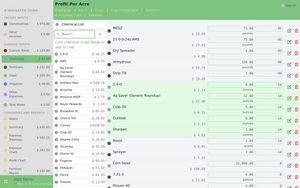
Profit per Acre is a web app that is used for calculating the projected profit on the acres that you farm. Instead of dealing with an ad hoc spreadsheet, or a hard-to-update piece of paper, why not go with the easy-to-use option of a web-based calculator?
Profit per Acre makes it easy to calculate the return on investment of different chemical programs or fertilizer products. As prices change, quickly see how your bottom line is affected and market your grain with confidence.